




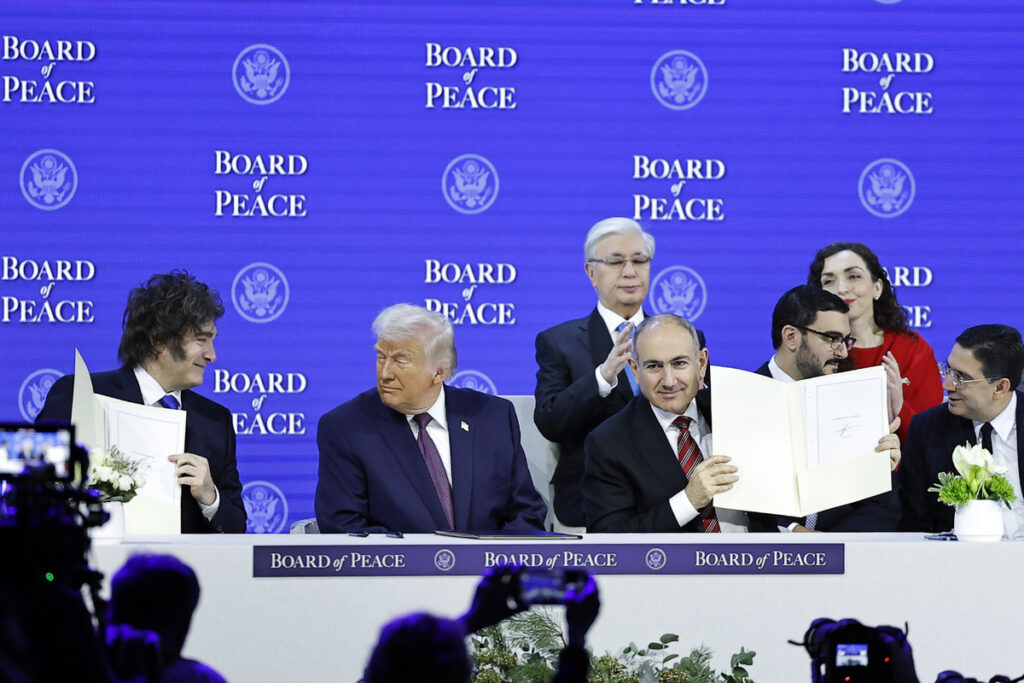
Armenia received a personal invitation from Trump and joined the initiative. Pashinyan thanked him and described it as “a step towards peace”. But why is Armenia among the “invitees”?
Armenia’s entry into Trump’s so-called “Peace Council” looks like yet another humiliation. Why is Pashinyan rushing to join it, and what real benefit can Armenia possibly gain from this?
Let us recall that this “Peace Council” is Trump’s latest initiative to “resolve” the Gaza crisis: gathering leaders from various countries into a “council” to discuss negotiations, “stabilisation” and “peace”. Trump has invited anyone he considers useful for his image as a “great peacemaker” — from Armenia and Azerbaijan to Belarus, Kazakhstan and even Russia.
Putin has already stated that he would consider the proposal and was prepared to transfer one billion dollars from assets frozen in the United States — a move that looks more like a provocative gesture. But what exactly is this “Peace Council”? Officially, it is about “global stability”; in reality, it is a media spectacle in which Trump plays the role of the “saviour of the world”, while the participants act as extras.
Armenia received a personal invitation and accepted it. Pashinyan expressed his gratitude and called it “a step towards peace”. But why was Armenia invited at all? Because Trump views the South Caucasus as part of US–Azerbaijani interests, where Armenia already plays the role of a “transit applicant”? After all, Aliyev recently claimed in Davos that Armenia itself had requested transit through Azerbaijani territory.
Here comes cynicism bordering on the absurd: Armenia takes a seat in a “Peace Council” on Gaza, where reconstruction and humanitarian aid for victims are discussed, while the entire Armenian population of Nagorno-Karabakh was expelled in September 2023, churches are being destroyed, Armenian prisoners remain in Baku’s jails, and Stepanakert (now Khankendi) is being repopulated with Azerbaijanis under the slogan of the “Great Return”.
Pashinyan and his team have long removed the issue of Nagorno-Karabakh from the agenda, under the pretext of “not reopening the Karabakh question”, claiming that it “belongs to the past” and that one must “focus on peace”. Pashinyan himself stated: “Raising the issue of the return of the population to Nagorno-Karabakh could lead to a new escalation and threaten Armenia’s security.” In other words, the victim must remain silent so as not to ‘irritate’ the executioner.
And in this “Peace Council”, Armenia is supposed to sit at the same table as Azerbaijan — an aggressor, an occupier that has carried out the complete de-Armenianisation of Nagorno-Karabakh — and pretend that everything is normal?! It is as if, after the 1915 genocide, Armenia had sat with Turkey in a council on “peace in Europe”, ignoring the genocide itself. Or as if Israel were to overlook the Holocaust in the name of “peace in Africa”. Disgusting — and even that word feels insufficient.
Moreover, no matter how hard Pashinyan tries to please Trump, Aliyev remains Trump’s favourite. It was with Aliyev that Trump held a personal meeting in Davos, and it is Aliyev who receives compliments such as, “Ilham, you are a great leader.” Pashinyan? No. No personal meeting in Davos, no “Nikol, you are a great leader”.
In reality, Trump openly demonstrates that within the same “Peace Council”, Baku is regarded as a strategically important and financially valuable partner, while Armenia is invited mainly to play the role of an extra and to create the illusion of regional balance.
Pashinyan rushes into this “Council” in order to appear as a “peacemaker” at home, but in fact it is a humiliation: you are in a room where your enemy is the star, and you are merely a background figure. A pure façade.
Truth and justice would require Armenia to insist that “Nagorno-Karabakh must be on the agenda of any ‘council’ — including Trump’s Peace Council — or we do not participate.” Otherwise, this is not diplomacy but a capitulation applauded by Trump. In other words, Armenia’s participation in the “Peace Council” on Gaza looks like yet another attempt by Yerevan to ‘change the subject’ on the international stage, aligning itself with the Middle East agenda in order to avoid discussion of its own territorial and demographic losses.
The mocking tone of the Azerbaijani media says it all: “With Azerbaijan, the United States will discuss supplies of defence products, including bulletproof vests and patrol boats. It is unlikely that Armenia needs military vessels on Lake Sevan, now renamed Geycha… Azerbaijan is becoming an increasingly valuable partner for the United States — that is real realpolitik, far more important than lofty rhetoric about the history of human rights.”
Main source: golosarmenii.am