




According to Seyran Ohanyan, in 2016 Armenia was able to repel the enemy thanks to preparation, national cohesion, and military conduct. In 2020, these factors were lacking. He accuses the authorities of mistakes, internal divisions, and failed mobilisation. The defeat led to territorial losses and weakened the security of Artsakh. The war could have been avoided through better-led policy.
As the anniversary of the 44-day war of 2020 approaches, the Armenian strategic debate remains dominated by a central question: was the defeat inevitable? Beyond technological explanations — drones, networked warfare, informational superiority — a more structural reading emerges, notably advanced by former Defence Minister Seyran Ohanyan: Armenia did not lose its military response capability as such, but saw the political, institutional, and organisational conditions that allow an army to transform resources into strategic effectiveness disintegrate.
This perspective shifts the focus: from armament to the state, from tactics to governance, from the battlefield to the politico-military architecture. It invites an understanding of the 2020 war not as an isolated shock, but as the product of a rupture in strategic continuity, both internal and regional.
Two wars, two strategic matrices
The recurrent comparison between April 2016 and autumn 2020 is, in this perspective, enlightening — provided its limits are recognised. In 2016, the Azerbaijani offensive was a contained operation: tactical gains, testing defensive lines, pressure on the negotiation process. Armenia’s response relied on a stable chain of command, prepared defensive infrastructure, the capacity to absorb the initial shock, and, above all, rapid mobilisation of human resources.
The episode led to institutionalised lessons learned: inquiry commissions, technical evaluations, adjustments to systems. This culture of post-combat adjustment — a hallmark of professional armies — contributed to strengthening internal confidence.
The 2020 war stems from a different matrix. It combined:
- long-term politico-military preparation on the Azerbaijani side,
- Turkish operational integration,
- massive use of drones and coordinated fire,
- simultaneous pressure across the entire depth of the front,
- coordination between military action and political-territorial objectives.
Yet, for proponents of a structural reading, technological superiority does not explain everything: it becomes decisive only when it encounters a disorganised adversary system.
The decisive variable: state continuity
Several analysts locate the breaking point in the 2018 political transition. Not as a mere change of government — a normal phenomenon in pluralistic regimes — but as a strategic discontinuity. Ohanyan and other security actors criticise the disruption of three continuities: diplomatic, institutional, and doctrinal.
Security diplomacy, particularly in the context of the multilateral negotiation framework on Karabakh, was based on accumulated practices, networks, and implicit compromises. Its political questioning may have been interpreted externally as a loss of predictability — and therefore of deterrent credibility.
Internally, the discursive delegitimisation of inherited institutions — the army, security apparatuses, administrative elites — contributed to weakening the functional authority of command structures. Modern war punishes not only material weaknesses but exploits fractures in legitimacy.
Finally, the security doctrine — a combination of threat assumptions, response scenarios, and alliance hierarchies — suffered from an unfinished phase of redefinition. The result: strategic ambiguity just as the regional environment hardened.
Mobilisation: the missing link
The concept of mobilisation occupies a central place in this analysis. It is not limited to calling up reservists. It denotes a state’s ability to convert all its functions — logistical, industrial, administrative, informational — into coherent support for the war effort.
Several failures are highlighted by critics of the 2020 conduct:
- failure to rapidly switch to a war economy,
- incomplete mobilisation of structured reserves,
- irregular rotation and reinforcement of units,
- unstable logistics flows,
- insufficient defensive works on breakthrough axes,
- deficient civil-military coordination.
In this reading, Armenian society did not lack will — but structure. Spontaneous mobilisation, if not integrated into a state architecture, produces dispersion rather than power.
The war here reveals a classical rule: national resilience is not merely a moral fact, but an administrative construction.
Technology and the explanatory illusion
The drone explanation — omnipresent in international commentary — is deemed reductive by this school of analysis. Unmanned systems undeniably altered tactical dynamics: destruction of armoured vehicles, neutralisation of defences, psychological pressure. But their effectiveness depends on the ecosystem: intelligence, targeting, fire coordination, relative air freedom.
In other words, technology produces an advantage when embedded in an integrated architecture — something the Turkish–Azerbaijani tandem successfully implemented. Conversely, a fragmented defence, however brave, suffers the cumulative effect of repeated strikes.
Focusing on the tool thus masks a more troubling question: why did adaptation not occur in time on the Armenian side, despite observable signals in other theatres (Syria, Libya)?
Artsakh: from strategic depth to enclave
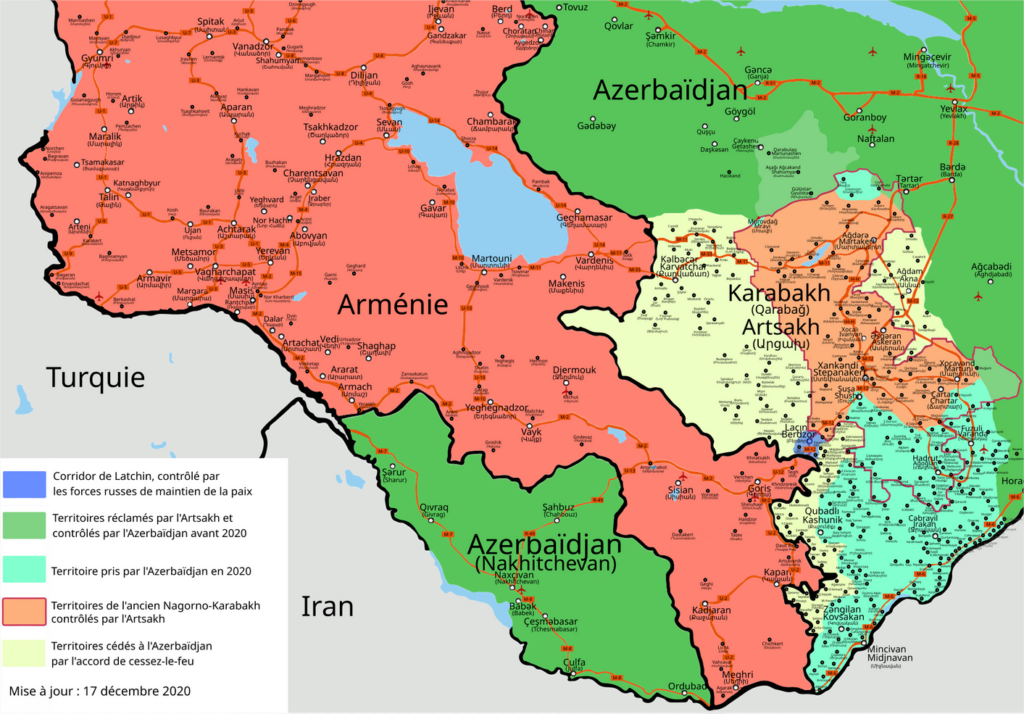
The territorial transformation resulting from the war profoundly alters the security equation. The loss of peripheral districts and strategic centres removed the defensive depth that previously absorbed the initial shock. Former fortified lines, distant from vital centres, have disappeared.
The current configuration presents several vulnerabilities:
- territorial discontinuity,
- dependence on narrow axes,
- logistical exposure,
- immediate proximity of enemy forces.
The presence of Russian peacekeeping forces becomes, de facto, a pillar of security. This shift of guarantee — from national to external — changes the nature of deterrence: it becomes conditional, negotiated, and dependent on broader geopolitical balances.
Regional reshaping: the Turkish factor
A major effect of the war is the assumed entry of Turkey as an operational actor in the South Caucasus theatre. Military cooperation, technological support, diplomatic alignment: the partnership with Baku reaches a qualitative threshold.
This projection fits into a broader strategy of influence: transport corridors, energy continuities, expanded politico-military presence. It introduces a medium-power actor with significant initiative capacity into a space historically structured by other balances — Russian, Iranian, Western.
For Armenia, this implies multidimensional pressure: military, economic, psychological. The 2020 war thus appears as one episode in a longer regional sequence.
Could the war have been avoided?
The thesis of avoidability rests on two levers: international guarantees and internal guarantees. The former involve diplomacy, negotiation frameworks, functional alliances. The latter involve national cohesion, military credibility, and crisis governance.
According to this approach, deterrence fails when these two levels deteriorate simultaneously. The window of opportunity then opens for the revisionist actor.
Even if conflict had become likely, better politico-military preparation would, according to its proponents, have allowed a more favourable stabilisation of the front — reducing the scale of territorial losses.
Defeat as a crisis of strategic governance
The conclusion goes beyond the Armenian case. It raises a universal question: what constitutes a state’s response capability? Not merely the arsenal, but coherence. Coherence of institutions, continuity of doctrines, credibility of alliances, discipline of decision-making chains.
The 2020 war, in this reading, demonstrates less military impotence than strategic disarticulation. Reconstruction would therefore be primarily institutional rather than material.
One question remains open: can a state weakened by defeat quickly restore this coherence in an increasingly constrained regional environment? The answer to this, more than the next arms acquisition, will determine future response capability.