




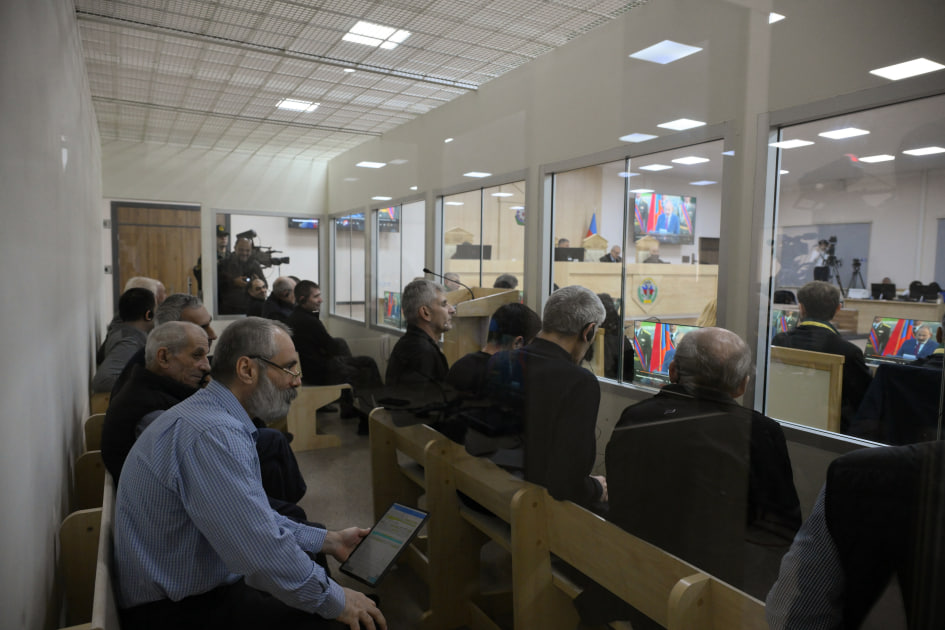
During another puppet trial, the Azerbaijani prosecutor’s office demanded life imprisonment for a number of representatives of the military and political leadership of Artsakh.
According to Azerbaijani media reports, the Azerbaijani prosecutor’s office demanded life imprisonment for former Artsakh President Araik Harutyunyan, former commander of the Artsakh Defence Army, Lieutenant General Levon Mnatsakanyan, former deputy commander of the Artsakh Defence Army David Manukyan, former Artsakh parliament speaker David Ishkhanyan, and former Artsakh foreign minister David Babayan.
At the same time, the prosecution demanded that former Artsakh presidents Arkady Ghukasyan, Bako Sahakyan, and Madat Babayan, who was captured by Azerbaijan, be sentenced to 20 years in prison.
Yesterday, it was also announced that the European Court of Human Rights (ECHR) had extended the deadline for providing information about Armenian prisoners in Baku. According to the Armenian Mission for International Legal Affairs, the deadline was extended on 7 November. ‘Accordingly, the relevant information from Azerbaijan must be submitted to the European Court by 18 November this year. For this reason, the Armenian government does not currently have the requested information,’ the mission said. It added that even if the Armenian government provides the information, it may not be made public by the ECHR.
The exact number of Armenian prisoners of war and hostages in Azerbaijani prisons remains unknown. Experts estimate the number to be several hundred. The Azerbaijani authorities currently confirm the detention of 23 Armenians. Among the prisoners are eight former and current members of the military-political leadership of Artsakh. They include former Artsakh presidents Arkady Ghukasyan, Bako Sahakyan, Arayik Harutyunyan, former foreign minister Davit Babayan, parliamentary speaker Davit Ishkhanyan, former commander of the Artsakh Defence Army General Levon Mnatsakanyan, General David Manukyan and former minister of state Ruben Vardanyan.
Azerbaijan is a dictatorial country, and the trial of the Armenians serves to strengthen President Aliyev’s authority. Human rights are repeatedly and flagrantly violated in this country. In addition, many international institutions and structures are no longer active in Azerbaijan. The relatives of Armenian prisoners are concerned about the suspension, since 3 September, of the activities of the International Committee of the Red Cross office in Baku. In reality, Azerbaijan is pursuing a policy of isolating Armenians detained there from the outside world. Can we resign ourselves to this? We are aware of numerous protests organised around the world by influential organisations such as the offices and committees of the Armenian Cause of the ARF, and, in Europe, notably by the ‘Europeans for Artsakh’ platform, as well as by the Armenian community in Switzerland and other structures that are raising the issue of the immediate and unconditional return of our hostages in various international forums.
What are the Armenian authorities doing in this regard? It would seem that the issue of returning Armenian prisoners should be one of the priorities on the agenda of both our country’s domestic and foreign policy. However, contrary to the foreign minister’s statements that they are using all international platforms to return prisoners, there are no results. Moreover, the political majority claims that they have a different agenda, and that the fate of the political leadership of Artsakh and the release of our remaining prisoners is not a priority for Pashinyan’s team. This was evidenced by the recent autumn session of Euronest in Yerevan, where deputies from the political majority simply refused to join the opposition deputies’ proposal for the unconditional release and return of our prisoners.
Yerevan does not intend to link the return of Armenian prisoners with the signing and ratification of a peace treaty, as Pashinyan has stated directly. Is it because he cannot or because he does not want to? That is the question. The longer the peace treaty negotiations dragged on, the more often he noted that ‘the release of prisoners is an issue to be resolved after the signing and ratification of the treaty.’ News from Baku gives no cause for optimism.
Pashinyan and Mirzoyan’s statements on the subject of our prisoners of war are strikingly different when comparing their statements in 2021, where they refer to the text of the Declaration of 9 November 2020, to the clause on the mandatory return of all prisoners of war, and their current defeatist statements.
Main source: armeniatoday.am