




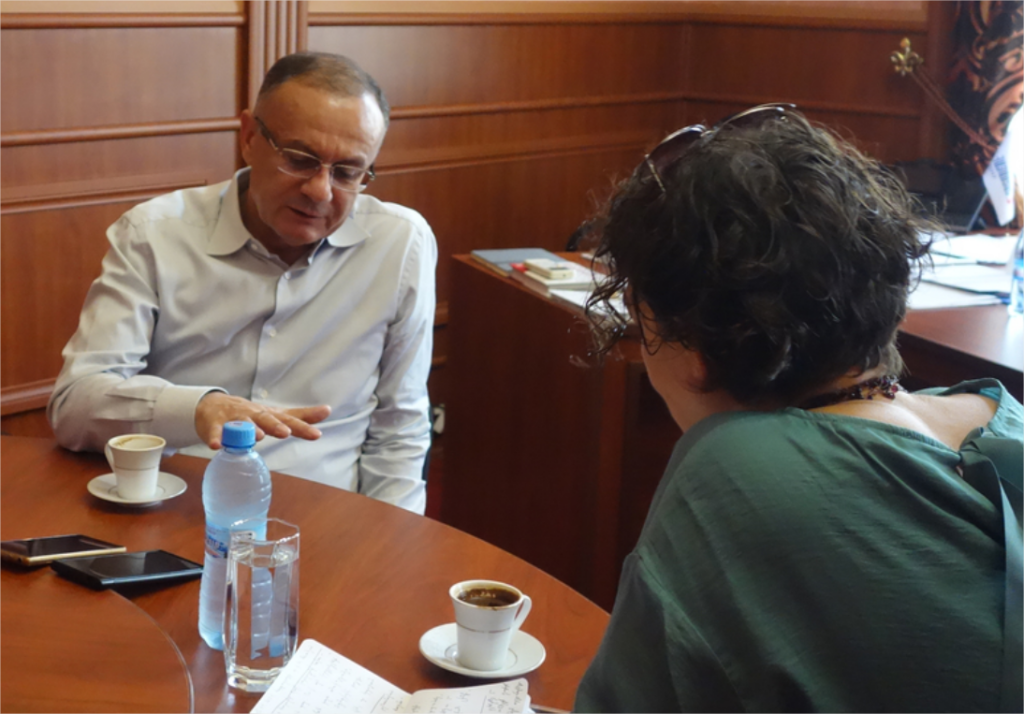
Seyran Ohanyan believes that the Armenian defeat during the 44-day war of 2020 was not inevitable. In his view, Armenia had the military, diplomatic and human resources necessary to avoid the war or, at the very least, to prevent such a significant defeat. He considers that the Armenian authorities failed to make use of the capabilities inherited from previous decades.
On the eve of the 44th anniversary of the war in Armenia, we met prominent representatives of the Armenian intellectual elite so that, with their help, we could understand and analyse what happened and what awaits us in the future. In the light of their answers, it may become clearer to us that our defeat does not end with the declaration signed on 9 November 2020; on the contrary, this is only the beginning, and major upheavals lie ahead, provided that we understand that the authorities of the Republic of Armenia and Artsakh have neither the political will nor the ability to put the situation right!
This decline will continue because the government is merely trying to explain why it was unable to do this or that. Had they devoted more effort to taking action rather than explaining themselves, our situation might not have been so bad. And this is without even mentioning betrayal or premeditation, although several indications of betrayal are evident, according to various specialists.
In 2016, it was possible to launch a powerful counter-offensive. Have we lost the ability to retaliate in 2020, or have the enemy forces increased in size, changed and become more powerful?
The two situations are not comparable in terms of scale. During the April 2016 war, Azerbaijan had specific offensive objectives against Artsakh, aimed at achieving a number of predetermined goals, securing a fundamental tactical advantage and subsequently changing the status quo and gaining the upper hand in the negotiation process by forcing Armenia and Artsakh into making further concessions.
Our level of preparedness in 2016 was such that we were able to determine the directions from which their main attack would come, as well as the directions of their secondary attack, and to stop them by making use of the training of our units, engineering structures and weaponry.
At the same time, after 2016, we rapidly established a commission to determine, among other things, what our strengths were. I mean that we wanted to establish the state of readiness of our troops and their moral and psychological condition, but also to examine the actions of the troops during combat operations and assess the quality of engineering equipment, weaponry and military equipment.
More importantly still, in 2016 we were able to unite the nation rapidly and voluntarily in support of Artsakh.
The situation was different in 2020. The enemy launched an attack against Armenia in view of the overall military and political situation in Armenia. The scale was different. Operations were conducted along the entire front line.
In the sectors where the enemy had managed to break through, we had blocked them in almost every direction, with the exception of southern Hadrut and Djrakan (Mekhakavan), where they succeeded in exploiting their breakthrough.
However, in conducting a genuine assessment, it must be pointed out that, following the change of government in 2018, contrary to our expectations that the new government would develop its exercises and training on the basis of the values and experience we had already acquired over the previous 27 years, they started again from scratch.
Let us remember that our country had been built upon Soviet values and international experience. These authorities, however, rejected everything.
One of these instances of starting from scratch concerned foreign relations, both bilateral and multilateral, on the international stage. The entire negotiating potential of the Minsk Group co-chairs concerning Artsakh was undermined. And where negotiations come to an end, another course of action, of course, begins: the use of force.
Another factor is that, following the change of power in 2018, the current authorities, as well as those who had previously been in power, took measures that divided society. They worked to diminish the effectiveness of such invaluable assets as national unity, the army, the entire security system and the state governance system. All of this led to military operations on such a large scale, and we were defeated.
To say that the Armenian people had no opportunity to unite, succeed and achieve victory through unity would certainly be wrong. However, if the state governance system and the military command system do not coordinate this process, the people cannot organise themselves independently.
In other words, the responsibility falls upon those occupying positions within the public administration system and possessing the necessary levers of power.
It turned out that the authorities of the Republic of Armenia were incapable of mobilising the nation or placing the state on a military footing so that everything could function properly.
Thirdly, they did not provide concrete support to the army. In other words, they failed to organise the army’s rear support system, and this in several areas: there was no specific military mobilisation, no general mobilisation of reservists, and no continuous supply of weapons and personnel.
Furthermore, once the enemy began to advance and attack, no military engineering fortifications were constructed to strengthen the defensive positions.
Fourthly, they did not take the necessary measures to establish general order, because there was considerable confusion and widespread agitation.
Quite the opposite: seeing all this dysfunction, they encouraged everyone. In other words, they awarded various medals, promoted military personnel to higher ranks and handed out Hero titles.
One could say that the authorities of the Republic of Armenia did everything to bring about the war, did nothing to ensure that the new war was conducted properly, did nothing to make our borders impregnable after the war ended, and, most importantly, encouraged this state of affairs.
In other words, the reason is not merely illiteracy, but also deliberate intent, which I perceive within these institutions. An educated person learns from their mistakes, or at least from the mistakes of others, whereas the mistakes made by these institutions are continuous. They still have not stopped making mistakes in every possible area.
Only 25% of Artsakh remains under Armenian control; it is not under enemy rule, but without strategically strong positions. Is it possible to defend it? Can Azerbaijan use it at any moment as a bargaining chip to obtain further concessions? What position are we in? Can we defend Artsakh militarily in the event of an attack?
In situations of this kind, a comprehensive assessment is generally carried out. I would like to provide a regional military and political assessment.
Firstly, taking advantage of this situation, the enemy has established an expanding Turkish-Azerbaijani tandem, reinforced by the support of certain Muslim countries and by groups of terrorists and mercenaries from Syria. Within this overall context, they reached the conclusion that Armenia was weak and that it had therefore become possible to launch military hostilities.
During the military hostilities, they were able to achieve success and secure certain advantages because of their unity, as well as through the use of certain new weapons. I am referring to new weaponry, drones and long-range systems.
But these factors alone would not have been enough had they not perceived the weakness of our unity, because it is possible to fight against all these things and achieve success. Otherwise, no country in the world would be able to fight against major powers.
Secondly, through this war, Turkey itself has entered the South Caucasus and continues to exert Turkish-Azerbaijani pressure on Armenia. To a certain extent, let us say, they are conducting psychological operations. For example, they are directing certain psychological pressure messages towards regional actors: Russia, Iran and Georgia.
But the worst thing is that Turkey has established itself in the South Caucasus. And the pressure on Armenia continues.
They are already exerting pressure along the Armenian border. Under the pretext of unblocking transport infrastructure, their long-term objectives are quite clear.
It is clear that they want to open a route from Turkey to Central Asia, but also towards the Far East and the Uyghurs of western China, and to create the unity of a Greater Turan, as well as to play a role in the region by openly confronting all these countries, including Russia, Europe, China and Iran in the Middle East.
We must understand clearly that Turkey is, first and foremost, a two-headed dragon with certain metastases.
Firstly, it is a large tumour beneath the abdomen of the Russian Federation.
Secondly, it is a source of a stroke in the head of Iran and in the Far East. On the other hand, it is a two-headed dragon, extending in one direction towards the West, towards Europe, and in the other towards Central Asia and the Far East, seeking to regain Turkey’s Ottoman position and its former role as a sultanate.
Let us regard this as a general assessment of our adversaries.
Now, what is the assessment when you ask questions about Artsakh?
Within the framework of our correct domestic policy and the regional security environment, we were genuinely able to liberate Artsakh and create the conditions for the people of Artsakh to exercise their right to self-determination in their historic homeland, and to have the opportunity to live and develop there.
We had effectively reunified Armenia and Artsakh and, under the concept of the trinity of Artsakh, Armenia and the Diaspora, we were pursuing overall development and the establishment of a comprehensive system in the region for its security and development in every respect: economic, historical and cultural.
Armenia, together with Artsakh, constituted a stronger and more powerful factor, at least in the areas of the economy, security and national unity.
The situation is now different. Artsakh has been weakened and encircled, while Armenia has also been weakened and completely shattered by the crisis following this war.
And it must be said that the Diaspora has become weaker.
Before the first liberation war of 1988–1994, the Diaspora was not what it was yesterday. Following the victory in the liberation war, the Diaspora became stronger.
Now, following this latest war, the Diaspora is beginning to weaken once again, because, ultimately, the Armenian factor that holds the Diaspora together is Armenia and Artsakh.
The backbone and the central axis of the Diaspora are Armenia and Artsakh. If Armenia and Artsakh are strong, the Diaspora is strong.
Now look: following this defeat, we have lost territories. Both Shushi and Hadrut, as well as the seven intermediate regions, which, for us, were territories belonging to the Republic of Artsakh and provided a certain degree of security. That security was located a considerable distance from Armenia.
At that time, we had another, more powerful system of frontline engineering fortifications. It was a system of frontline engineering fortifications linked to the Republic of Armenia, and this is why, for example, the enemy was able to advance only 20 kilometres along a 283-kilometre section of the front.
Thanks to the heroism of our soldiers and commanders, we were able to hold the frontline, but the state was unable to close this gap.
Now we are in a different situation. The border and the line of contact are different. Everything has to be built from scratch, and the geographical configuration is such that Artsakh is in an enclave.
Today, the guarantor of security in Artsakh is not primarily its army, but the Russian Federation’s peacekeeping forces.
This is not because the Artsakh army is weak, but because significant units of the Artsakh Defence Army and part of its defensive positions were handed over to Azerbaijan in this way, without a single shot being fired.
Today, the Artsakh Defence Army is already carrying out certain security tasks along a specific, localised tactical line of contact, in cooperation with the Russian Federation’s peacekeeping forces.
Strategically speaking, if Armenia’s security system is not strengthened and Azerbaijan attempts to launch hostilities, resistance will be extremely difficult for the Artsakh Defence Army.
This is because, in 1992, we were in a somewhat stronger position, but through our counter-offensive we were able to expand our territory and establish stronger security for Armenia and Artsakh.
That is the overall answer.
Of course, could the war have been avoided?
Of course, the war could have been avoided, because preventing a future war requires the preparation of the security and defence system, which involves not only the defence sector but the entire country.
In other words, the areas involved in preventing war include the country’s territory, its population, its economy, the army and its mobilisation capabilities, patriotic education, and the collective will expressed through the state in question.
And within this entire system, two areas of activity are pursued in order to establish security guarantees.
The first consists of international guarantees. These are foreign relations and the full use of the negotiating potential.
The second consists of internal, national guarantees: in other words, internal unity, the security system and the proper use of the army.
Indeed, if the international guarantees had been fully utilised, the war could have been avoided.
And if the national guarantees had been properly employed, it would have been possible to avoid the war.
It would certainly have been possible, if not to achieve victory in this war, then at least to achieve success, so that we could have stopped them in those areas and avoided finding ourselves in such a weak position, particularly by surrendering Hadrut and Shushi, the regions of Kashatagh, Karvachar and Akna.
And even now, there are already signs of capitulationist sentiment emerging within the borders of the Republic of Armenia.
What concrete options does the government have today?
The weakness of the current authorities is that they stop at nothing.