





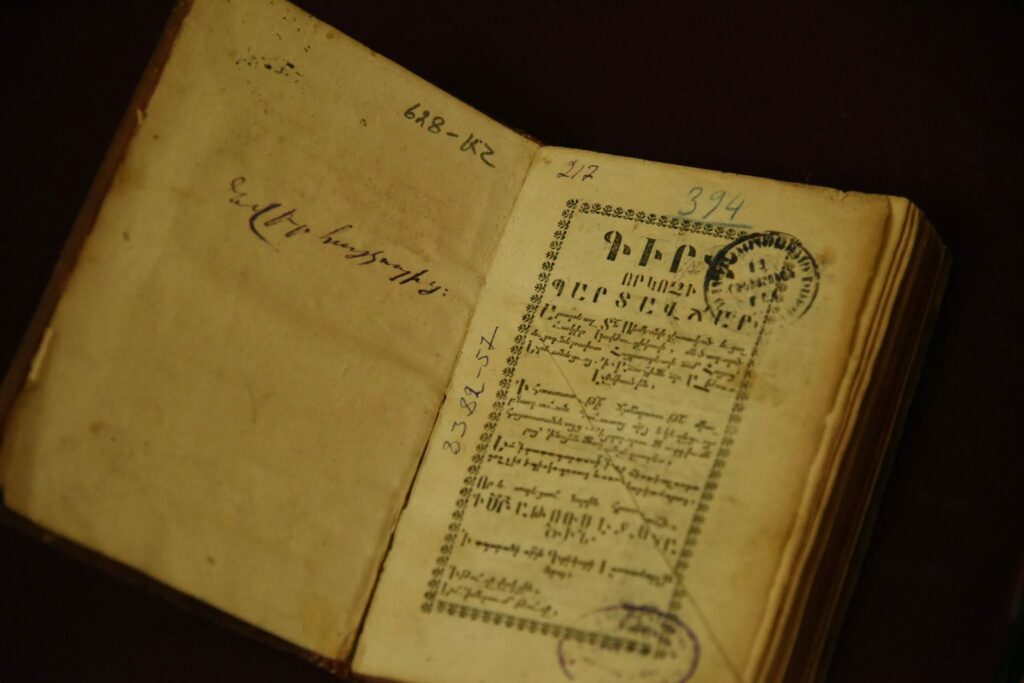
The Etchmiadzin Printing House is not merely a historical enterprise, but one of the most important institutions ensuring the preservation of Armenian culture, language, historical memory and spiritual heritage. The printing house founded by Simeon of Yerevan and Grigor Khojajanyan is now 255 years old.
In 1771, in Vagharshapat, on the grounds of the Mother See of Holy Etchmiadzin, the long-awaited printing house opened — the first on the territory of Armenia. Its initiator and founder was Simeon I of Yerevan, Catholicos of All Armenians.
Simeon I had become acquainted with the printing trade even before ascending the Catholicosal throne, during his journeys to Constantinople and Smyrna. For many years, he had cherished the idea of establishing printing in his homeland.
The money required to construct the building was provided by a wealthy Armenian merchant from India, Grigor Khojajanyan (Chakikents). The future “house of books” cost him 3,106 gold coins. But the work did not end there. Although the printing house had begun publishing its first books as early as 1772, organizing the publishing process proved difficult because of the high cost of imported raw materials, above all paper.
In 1776, Grigor Khojajanyan decided to support the printing house once again and allocated 7,800 Persian tomans to establish a paper mill in Armenia. It was clear that producing paper locally would be easier and less expensive.
The Mother See of Holy Etchmiadzin is located in the Ararat plain, which is rich in artesian water. Since ancient times, our ancestors in this area had also cultivated and processed cotton. This meant that all the prerequisites for paper production existed near Vagharshapat. All that remained was to find craftsmen skilled in the techniques of papermaking.
With Simeon of Yerevan’s approval, Khojajanyan invited two Frenchmen from Constantinople to work in Armenia: Besson and Desior, who had earned a strong reputation in the field of papermaking.
The Armenian merchant promised to cover all their expenses for three years. However, although the craftsmen had agreed, they continually postponed the start of work. It turned out that they had promised not to disclose the secrets of paper production. Khojajanyan was forced to put pressure on them and even resort to a trick, threatening to have them imprisoned if they withdrew from the agreement. The craftsmen had no choice but to begin the work, and soon the first batch of paper produced in Armenia appeared at the Etchmiadzin printing house.
Besson and Desior’s Armenian apprentices learned quickly and soon mastered the intricacies of papermaking, organizing the production of this valuable material without further assistance from the Frenchmen. The printing house began operating at full capacity, becoming a vivid chapter in the history of the Armenian people’s cultural and intellectual revival.
This story was presented by Arman Manasyan, Candidate of Historical Sciences, the main guest at an event held at the National Library of Armenia to mark the 255th anniversary of the Etchmiadzin printing house.
The celebration was organized by the library’s Scientific Reading Room and Periodicals Hall. They had also prepared an exhibition of the printing house’s old editions, books published under its roof over the years, and other rare materials held in the collections of the National Library of Armenia and possessing bibliographic value.
Over more than a quarter of a millennium, the Etchmiadzin printing house has followed a remarkable path, evolving from a modest print shop into a major publishing center. Today, it continues to publish books on the most current subjects, including Armenian Christianity and its history, as well as issues of national identity, culture and heritage.
From the day it was founded, the printing house was named after Gregory the Illuminator, which immediately defined its mission: to bring the ideas of enlightenment to the people for the sake of the Armenian nation’s spiritual and intellectual development.
Although the history of Armenian printing began much earlier, in 1512, when the clergyman Hakob Meghapart published the first Armenian-language book, the “Urbatagirk” (Book of Fridays), in Venice, the establishment of a printing house on the territory of Armenia itself was a turning point for the country’s publishing industry. Active publication of Armenian-language books began in the country, positively influencing the development of society’s spiritual and educational life and the preservation and dissemination of the national cultural heritage.
“From the very first years after the invention of printing, Armenians began attaching even greater importance to the role of writing and books, seeking to do everything possible to take part in this progressive process,” Arman Manasyan noted. “There was no opportunity to publish books in the homeland because Armenia was divided between the Ottoman Empire and Safavid Persia. Printing therefore had to be organized in cities and countries with Armenian communities: first in Venice, then in Livorno, Constantinople, Saint Petersburg, Moscow, Nor Nakhichevan (now Nakhichevan-on-Don), and other cities.”
According to Manasyan, establishing a printing house on Armenian territory was a tremendous achievement. One year later, the first book printed in the country came off its presses: Simeon of Yerevan’s 180-page work, “Spiritual Garden” (Prayer Book). As the historian noted, not a single copy of this edition has survived to the present day. However, many other books from the printing house’s first publications have come down to us, including Psalters, collections of songs and New Testaments.
The printing house’s first building had one floor; a second floor was added only later. Because of the Russo-Turkish and Russo-Persian wars, the printing house remained inactive until the 1830s, when it finally became possible to resume its work. In 1889, Catholicos of All Armenians Makarios I of Teghut rebuilt the upper floor, giving it an architectural style consistent with the lower floor. The present building, constructed of black tuff, is that same structure in the form it took after its reconstruction at the end of the 19th century.
Arman Manasyan also highlighted another important event: the establishment of the official “Ararat” periodical of the Mother See of Holy Etchmiadzin. Thanks to Catholicos of All Armenians Gevorg IV, it began publication in 1868 and became the first official periodical publication devoted to Armenian studies in the Caucasus.
During the tenure of Catholicos of All Armenians Khrimian Hayrik, the printing house was modernized. For this purpose, Father Gyut Aghanyants, a representative of the Tiflis Diocese of the Armenian Apostolic Church, was sent to Europe. In 1895–1896, he succeeded in purchasing modern printing presses and transporting them to Vagharshapat. In 1896, the Etchmiadzin printing house received a special award at the All-Russian Printing Industry Exhibition.
During the Soviet years, publication of the “Ararat” periodical, as well as the printing house’s own operations, was suspended. The revival of the publication began after the end of the Second World War, when the periodical resumed publication under a new name: “Etchmiadzin.”
A new stage in the development of the “Gregory the Illuminator” printing house coincided with the reign of Catholicos of All Armenians Vazgen I. At his initiative, the building was restored between 1959 and 1962 with donations from the Armenian community in the United States.
“This was not a theological or doctrinal journal. From its very foundation, it became a platform for important national topics and ideas. It is no coincidence that the works of prominent scholars from various fields of that period were published in its pages. It is enough to mention such names as Sedrak Mandinyan, Nikoghayos Zuryan, Manuk Abeghian, Hrachia Acharian, Stepan Malkhasyants, Gurgen Edilyan and Komitas to understand the value of this publication,” Arman Manasyan continued.
According to the historian, among the books published by the printing house, several have particular historical and Armenological significance. These include “History of the Armenians” by Ukhtanes of Sebastia and “The Jewish War” by Flavius Josephus, which was one of the sources used by the fifth-century Armenian historian Movses Khorenatsi, as well as numerous other works.
He placed particular emphasis on the two-volume work by Bishop Hovhannes Shahkhatunyants, “Description of the Holy Cathedral of Etchmiadzin and the Five Provinces of Ararat.” As Manasyan stressed, the unique value of this work lies in the fact that many of the settlements mentioned in it no longer exist today. Their detailed descriptions, however, are important testimony to their historical belonging to the Armenians and their settlement by Armenian ancestors.
In 1962, the printing house was transferred to the Academy of Sciences of the Armenian SSR. It was only in 1991 that it was definitively returned to the Mother See of Holy Etchmiadzin, thoroughly renovated and equipped with the latest printing technology.
The next modernization phase took place in 2015, when extensive renovation work was carried out at the printing house with the financial support of benefactor Vache Manukyan.
Concluding the anniversary event, Arevik Chakharyan, head of the National Library of Armenia’s Scientific Reading Room, emphasized that the establishment of the printing house at the Mother See of Holy Etchmiadzin was a turning point in the history of Armenian printing. In her words, if Mesrop Mashtots created one of the Armenian people’s principal spiritual weapons — the alphabet —, the Etchmiadzin printing house multiplied its power by bringing Armenian-language books to every Armenian home.
Main source: golosarmenii.am